Artificial intelligence has made graphic design more accessible than ever before. Today, anyone can generate a flyer, social media graphic, or advertisement in just a few minutes using AI-powered design tools. For startups, freelancers, and small business owners with limited budgets, that’s an incredible advantage. It allows ideas to move from concept to execution much faster than they could even a few years ago.
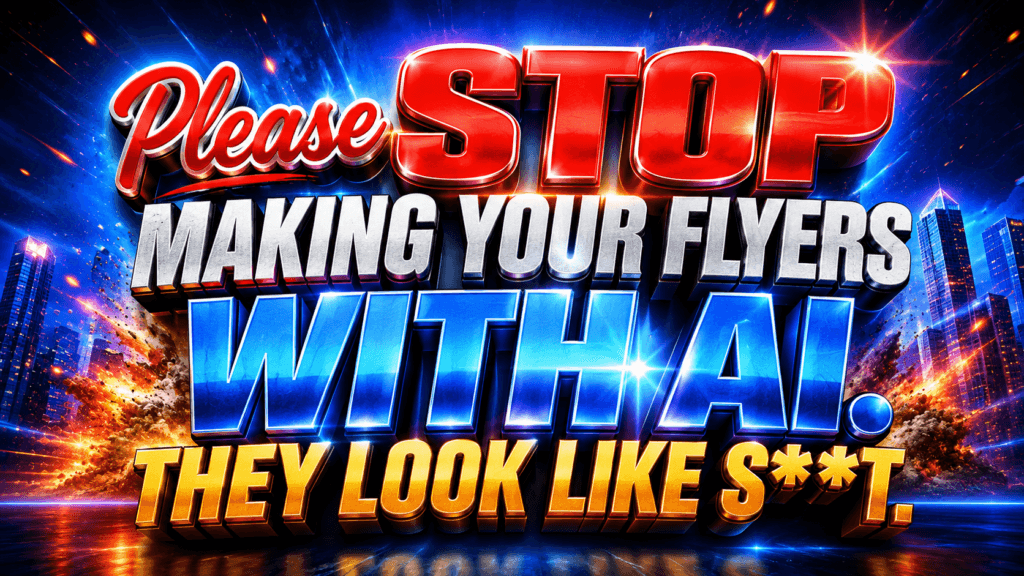
Still, after seeing hundreds of AI-generated flyers across social media, I understand why the phrase “Please Stop Making Your Flyers With AI” resonates with so many designers. The problem isn’t artificial intelligence itself. The problem is assuming that generating a design is the same as creating effective visual communication. They’re not interchangeable, and the difference becomes obvious the moment someone looks at the finished product.
A flyer has one job: communicate a message clearly and persuade someone to take action. Whether that action is attending an event, purchasing a product, or contacting a business, every design decision should support that goal. When AI becomes the only designer in the room, those decisions often disappear.
AI Can Generate Graphics. It Can’t Understand Your Audience.
Artificial intelligence is remarkably good at recognizing patterns.
It has analyzed millions of advertisements, posters, websites, and marketing materials. That’s why it can produce something that resembles professional design within seconds. It understands visual trends, common layouts, and popular styles because it has seen them repeatedly.
What AI doesn’t understand is your business.
It doesn’t know why your customers choose you over a competitor. It doesn’t understand your brand personality, your customer journey, or the emotions you want your audience to feel. It has no firsthand experience with your products or services. Unless someone provides that strategic direction, AI fills in the gaps with assumptions based on patterns rather than purpose.
That’s why so many AI-generated flyers end up looking polished at first glance but forgettable after a closer look.
The Biggest Mistakes I Keep Seeing
After working with businesses across different industries, I’ve noticed the same design problems appearing again and again. Ironically, these issues existed long before AI became mainstream. Artificial intelligence simply makes them easier to reproduce at scale.
Many flyers try to say everything at once. Headlines compete with subheadings. Multiple fonts fight for attention. Bright colors appear without any relationship to the brand. Decorative effects overwhelm the message instead of supporting it. The result is a design that feels busy rather than effective.
Stock images create another common problem. AI often generates visuals that look technically impressive but have little connection to the business they’re representing. The flyer might look modern, but it doesn’t feel authentic. Instead of reinforcing the brand, it could easily belong to any company in any industry.
These aren’t software problems. They’re communication problems.
Good Design Starts With Questions
Whenever I begin designing marketing materials, I don’t open Photoshop or Canva immediately.
I start by asking questions.
- Who is this flyer for?
- What action should the reader take?
- What’s the most important message?
- Where will this be displayed?
- How much information does someone actually need?
The answers influence every creative decision that follows.
Typography becomes easier to choose because readability matters more than decoration. Colors support the brand instead of competing with one another. Images reinforce the message instead of distracting from it. White space becomes intentional because it helps people focus instead of overwhelming them with information.
Design is problem-solving before it becomes decoration.
More Effects Don’t Create Better Design
One reason AI-generated flyers often look similar is because they’re designed to impress instantly.
Glowing text.
Three-dimensional effects.
Heavy shadows.
Multiple gradients.
Lens flares.
Exploding backgrounds.
Every visual element competes for attention at the same time.
Ironically, the more visual noise a flyer contains, the harder it becomes to identify the most important information. If everything is shouting, nothing stands out.
Professional designers understand that hierarchy matters more than decoration.
A strong headline should attract attention.
Supporting information should answer questions.
A clear call to action should tell people exactly what to do next.
Everything else exists to support those three objectives.
AI Is Most Powerful When It’s Part of the Process
Despite the title of this article, I don’t believe businesses should avoid AI altogether.
I use AI regularly. It helps me brainstorm ideas, organize research, speed up repetitive tasks, and explore creative directions faster than I could on my own. Used thoughtfully, it’s one of the most valuable productivity tools available today.
The difference is that AI never replaces my decision-making. I still determine the strategy. I still evaluate whether a design communicates clearly. I still refine layouts, rewrite headlines, adjust spacing, and make choices based on the audience instead of accepting the first result a machine produces.
AI accelerates execution. It doesn’t replace experience.
Your Brand Deserves More Than a Prompt
One of the biggest risks businesses face is becoming visually indistinguishable from everyone else.
As AI tools become more accessible, millions of companies are using the same prompts, the same templates, and the same design trends. That creates an internet filled with marketing materials that feel familiar but forgettable.
Strong branding requires intention.
Your visuals should reflect your personality, your values, and the experience customers can expect when working with you. Those qualities come from understanding your business, not simply describing it to an AI model.
That’s why professional designers continue to play such an important role. We aren’t hired because we know which buttons to click. We’re hired because we know which decisions create better communication.
Great Design Is Measured by Results
The software used to create a flyer is rarely what determines its success.
Your audience doesn’t ask whether the design came from Photoshop, Canva, Figma, or an AI generator. They respond to whether the message is clear, whether the brand feels trustworthy, and whether the design encourages them to take action.
Research from Adobe’s State of Create report found that 89% of business leaders believe creative thinking is increasingly important to economic growth and business success.
That finding reflects something I’ve experienced throughout my career.
Businesses that invest in thoughtful branding and strategic design don’t just look more professional. They communicate more effectively, earn trust more quickly, and create stronger customer experiences.
Final Thoughts
So, should you stop making your flyers with AI? Not necessarily.
You should stop expecting AI to replace strategic thinking.
Technology has always changed the way creatives work. The arrival of Canva didn’t eliminate designers. Stock photography didn’t eliminate photographers. AI won’t eliminate creative professionals either. It simply changes the tools we use.
At the end of the day, your audience doesn’t remember the software behind your flyer. They remember how clearly your message was communicated and how your brand made them feel.
Good design has never been about the tool. It’s always been about the thinking behind it.
Connect With Me
Whether you’re building a new brand or improving your existing marketing materials, I can help you create designs that are clear, strategic, and built around your audience. From branding and social media graphics to websites, presentations, and digital marketing assets, my goal is always the same: create visuals that communicate with purpose.
If you’re ready to elevate your brand beyond templates and one-click designs, let’s talk.